
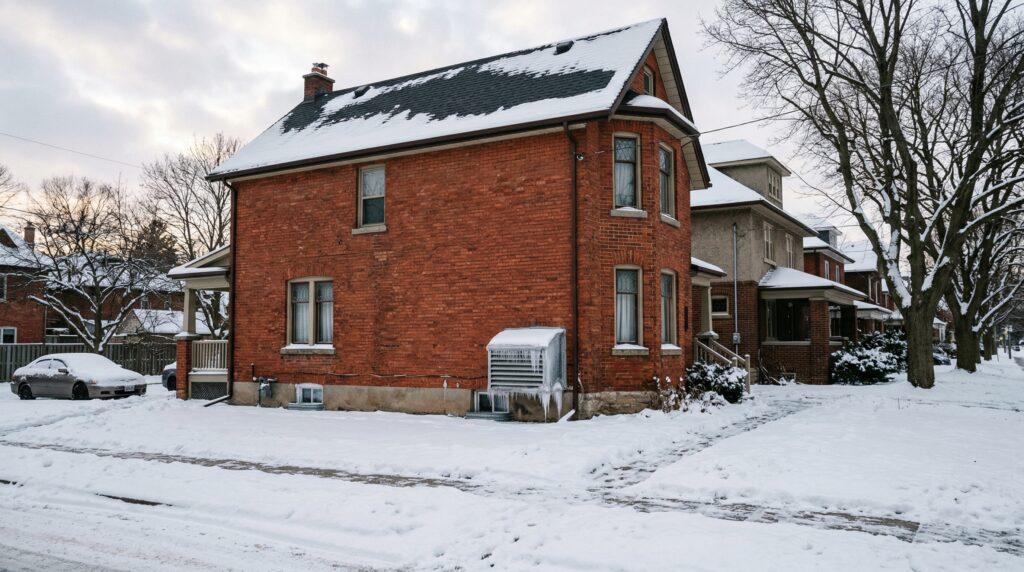
If you’re shopping for a new electric range or dryer and you live in one of Hamilton’s older neighbourhoods, the appliance is rarely the hard part. The wiring behind the wall is. Homes in Durand, Kirkendall, Strathcona, Beasley, Corktown, Crown Point, Stipley, Gibson, and the North End were mostly built before electric ranges and dryers existed as a household standard, and a lot of that original electrical infrastructure is still doing the job decades later.
What’s actually behind the wall in these neighbourhoods
A significant share of pre-1950 Hamilton homes still have some combination of a 60-amp electrical service, an old fuse panel instead of modern breakers, knob and tube wiring in at least part of the house, and two-prong outlets with no ground wire. None of that was a problem when the house was built. It becomes a problem the moment you want to add a modern electric range or dryer, both of which need a dedicated 240-volt circuit that a lot of these older services simply weren’t built to provide.
Why a modern range or dryer needs its own circuit
A standard electric range and an electric dryer both draw far more power than the lighting and small-appliance circuits an older home was designed around. They need their own dedicated 240-volt circuit, sized correctly and run back to a panel that can actually support the load. On a 60-amp service already carrying the rest of the house, there frequently isn’t room left for a new heavy appliance circuit without upgrading the panel itself. This is one of the most common reasons a straightforward appliance swap in one of these neighbourhoods turns into a bigger project than anyone expected.
What we can do and what we can’t
We repair and install appliances. That’s the job. Panel upgrades, new circuits, and anything involving the wiring itself belong to a licensed electrician, and we’ll tell you plainly when that’s what a job actually needs rather than trying to force an appliance into a circuit that can’t handle it. If you’re getting a range or dryer installed and the existing outlet or circuit doesn’t match what the new unit needs, that’s the point where an electrician needs to be involved before we can safely finish the job.
Gas as an alternative
A gas range or gas dryer sidesteps most of this problem, since gas appliances typically need only a standard household circuit for their electronics and controls, not a dedicated high-draw circuit. For a home where running new heavy-gauge wire back to the panel is a real headache, switching to gas is often the more practical route than upgrading the electrical service just to support one appliance. It’s worth discussing with whoever is installing the appliance before deciding.
What this looks like in practice
A common scenario in Durand or Kirkendall: a homeowner orders a new electric range to replace a decades-old one that’s finally worn out, assumes the swap is a straightforward like-for-like job, and then finds out on delivery day that the existing outlet is rated for a smaller load than the new range needs, or that the circuit feeding it also happens to be carrying half the kitchen’s lighting. None of that shows up until someone actually looks at the panel and traces the circuit, which is exactly why it’s worth doing before the appliance shows up rather than after.
The same story plays out with dryers in Stipley and Gibson, where a lot of homes originally built without a laundry room at all had one added into a basement corner decades later, sometimes with a circuit that was adequate for an older, lower-draw dryer but not for a larger modern one.
What to check before you buy
A few minutes of homework before ordering a new range or dryer saves a lot of frustration on delivery day.
- Look at your panel. If it’s a fuse box rather than breakers, or if it’s labelled at 60 amps, plan on an electrician’s opinion before the new appliance arrives.
- Check the outlet the current appliance plugs into. A three-prong 240-volt outlet doesn’t guarantee the circuit behind it is rated for a bigger, newer unit. Amperage and wire gauge matter as much as the plug shape.
- Ask whether any part of the run to that outlet is knob and tube. It’s common in homes from this era for one circuit to have been upgraded while others were never touched.
- Get the electrical question answered first, then buy the appliance. It’s a much easier conversation before delivery than after a range is sitting in your kitchen with nowhere to plug it in.
The insurance question homeowners ask
Knob and tube wiring comes up constantly with home insurance, and homeowners in Corktown, Beasley, and the North End ask about it often. The honest answer is that policies and requirements vary by insurer, and it’s a question to put directly to your own insurance company rather than assume one way or the other. If you’re already having electrical work done for a new range or dryer circuit, it’s a reasonable time to ask your insurer whether that work affects your policy at all.
Frequently asked questions
Can MAX Appliance Repair upgrade my electrical panel for a new range?
No. We repair and install appliances, but panel upgrades and new circuits are electrical work that needs a licensed electrician. We’ll tell you clearly if that’s what your installation needs before we proceed with anything.
Do all old Hamilton homes still have knob and tube wiring?
Not all of them. Many have been partially or fully rewired over the decades, especially in kitchens and laundry areas where load has increased the most. It varies house to house, which is why checking your specific panel and circuits matters more than assuming based on the neighbourhood.
Is a gas range easier to install in an older home?
Often, yes, since gas ranges typically only need a standard household circuit for their electronics rather than a dedicated 240-volt line. It’s worth discussing with your installer if your home’s electrical service is limited.
What’s the difference between a fuse panel and a modern breaker panel?
A fuse panel uses replaceable fuses that burn out under overload, while a breaker panel uses switches that trip and can be reset. Fuse panels are common in older Hamilton homes and often have less overall capacity than a modern breaker panel of the same era.
Should I ask my insurance company about knob and tube before buying an appliance?
It’s worth asking regardless of the appliance purchase, since insurance requirements around knob and tube vary by insurer. If new electrical work is happening anyway for a range or dryer circuit, that’s a natural time to raise it with them.
Book a Hamilton stove or dryer installation
If you’re installing a new range or dryer in an older Hamilton home, call (289) 768-1936 and we’ll walk you through what the appliance needs and flag anything that should go to an electrician first. We handle stove installation, dryer installation, stove repair, and dryer repair across Hamilton seven days a week. If winter vent issues are part of what’s driving the replacement decision, this guide on winter dryer vent problems covers that separately.
