
Hamilton’s tap water is hard everywhere in the city, not just in certain neighbourhoods, because the whole city draws from the same source. What actually varies by neighbourhood is plumbing age and how hot your water runs, not the hardness of the water itself. Either way, if you’re descaling a kettle every few months or your dishwasher isn’t drying like it used to, hard water is almost certainly part of the story.
One water supply, not several
Hamilton draws its municipal water from Lake Ontario through the Woodward Avenue treatment plant, and that supply serves the city as a single system. There isn’t a harder-water side of town and a softer-water side. The water leaving Woodward Avenue sits in the hard range, around 125 to 140 mg/L as calcium carbonate, and it stays that way as it moves through the distribution network. What changes house to house is older copper or galvanized plumbing that can add its own mineral scale over the decades, and how hot a given hot water tank runs, since heat is what turns dissolved minerals into visible limescale in the first place.
Outside the city itself, it’s a different story. Flamborough, rural Glanbrook, and the smaller towns further out often rely on private wells rather than the municipal system, and well water hardness varies enormously from one property to the next depending on the local aquifer. A homeowner on well water has no reliable way to guess their hardness without an actual test.
What scale does inside a dishwasher
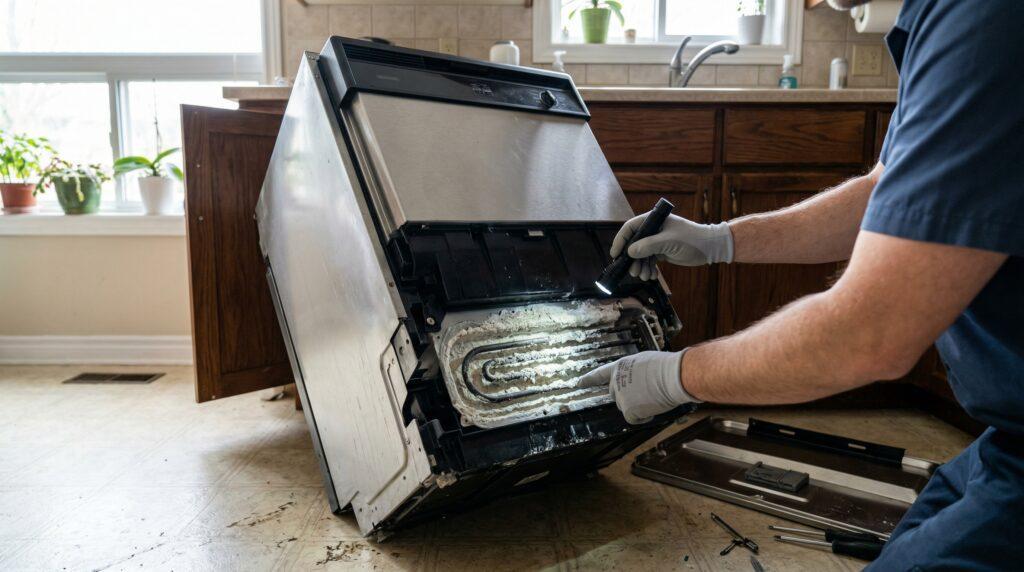
Every cycle heats water and pushes it through a heating element, a circulation pump, and a set of spray arm jets. Heat is exactly what causes dissolved calcium and magnesium to drop out of solution and bond to the hottest, most turbulent surfaces first. Over time that shows up as a heating element that can’t transfer heat efficiently, leaving dishes wet at the end of a dry cycle, and a pump that runs louder as scale narrows the internal clearances. The full breakdown of how this plays out inside a dishwasher covers the specific parts that fail first and in what order.
What it does to a kettle
A kettle has no filter and no defence against scale at all. It’s the appliance in the house that shows hard water damage first and most visibly, usually as a white crust forming along the heating element and the waterline inside the vessel. Left alone, that buildup insulates the element from the water it’s supposed to be heating, which means longer boil times and, eventually, an element that fails outright. A kettle is also the cheapest and easiest thing in the house to descale regularly, since most models just need a vinegar or citric acid soak with no disassembly required.
What it does to an espresso machine
This is where hard water gets expensive fast. An espresso machine’s thermoblock or boiler runs at a higher, more consistent temperature than a kettle or dishwasher, which accelerates scale formation inside a much smaller, more precise space. Once scale narrows the internal channels of a thermoblock, water flow and pressure both drop, which shows up as weak, inconsistent shots long before the machine fails outright. Boiler-based machines are a bit more forgiving because there’s more internal volume for scale to accumulate before it causes a real problem, but the underlying mechanism is identical. Machines with a built-in water filter or hardness sensor buy some time. They don’t eliminate the problem.
Slowing the damage without a whole-home fix
A few habits meaningfully extend the life of anything in the house that heats water.
- Descale on a schedule, not when something already looks wrong. By the time a kettle tastes off or an espresso shot slows down, scale has usually been building for a while.
- Use rinse aid in the dishwasher every cycle. It lowers surface tension so water sheets off dishes instead of beading and depositing minerals as it dries.
- Check whether your dishwasher already has a built-in softener. Some Bosch and Miele models include an internal salt reservoir specifically for this. If yours has one and nobody’s ever filled it, that’s worth checking before anything else.
- Use filtered water in an espresso machine wherever the model allows it. It’s a much smaller volume to filter than a whole-home system, and it protects the most scale-sensitive appliance in the kitchen.
When to call for repair
If a dishwasher is leaving dishes wet or streaked, if a kettle takes noticeably longer to boil than it used to, or if an espresso machine’s shots have gotten weak and inconsistent, scale is worth ruling out before anything else. Dishwasher repair and coffee machine repair calls in Hamilton trace back to hard water more often than any single mechanical fault, and a technician can usually tell the difference between scale damage and an unrelated failure on the same visit. We also work on specific machines like Jura and De’Longhi units, both common in Hamilton kitchens and both prone to showing scale damage in slightly different ways.
Frequently asked questions
Is the water actually harder in some Hamilton neighbourhoods than others?
No. The whole city draws from the same Lake Ontario supply through the Woodward Avenue plant, so hardness is essentially uniform. What varies is plumbing age and hot water temperature, which affect how visible the scale buildup becomes in a given home.
Is well water outside the city harder than city water?
Often, but it varies a lot. Flamborough, rural Glanbrook, and other outlying areas on well water can range from mild to very hard depending on the local aquifer, and there’s no way to know without testing that specific well.
Will a water softener stop scale damage completely?
It reduces it significantly by removing most of the calcium and magnesium before it reaches your appliances, but it doesn’t undo existing damage to a heating element or thermoblock that’s already scaled.
How often should I descale an espresso machine?
It depends on how often you use it and whether you’re using filtered water, but a regular schedule matters more than any specific interval. A machine used daily needs it far more often than one used on weekends.
Does rinse aid actually help with hard water in a dishwasher?
Yes. It doesn’t remove minerals from the water, but it changes how water behaves on the dish surface, which reduces visible spotting and film even though the underlying hardness hasn’t changed.
Book a Hamilton dishwasher or coffee machine repair
If hard water has caught up with your dishwasher, kettle, or espresso machine, call (289) 768-1936 and we’ll sort out what’s scale damage and what isn’t, same-day for most morning calls in Hamilton.
