

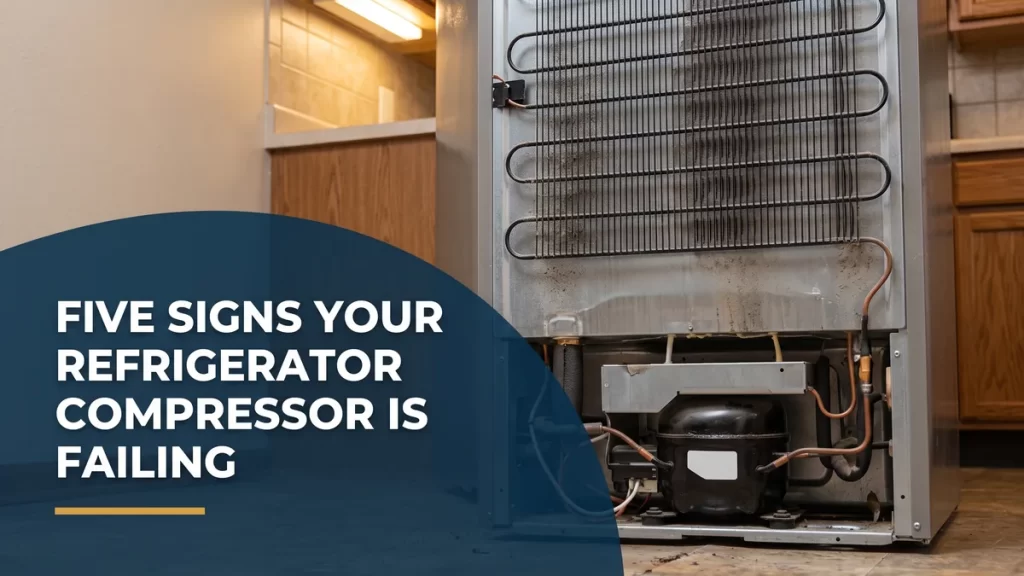
If your fridge on the Mountain runs louder in July and struggles to keep the freezer cold in January, the compressor isn’t broken, it’s working overtime. Homes on Hamilton’s escarpment and up on the Mountain see wider temperature swings than the lower city, and that swing is exactly what shortens a compressor’s working life. Here’s why it happens and what a homeowner can actually do about it before it turns into a repair call.
Why elevation and exposure change the math
A compressor’s job is simple in theory: move heat out of the fridge cabinet and into the surrounding room. That’s easy when the room sits at a steady temperature. It gets harder the wider that room’s temperature swings, because the compressor has to work against a bigger gap between inside and outside. Homes along Concession Street, Upper James, and the Rymal corridor, along with the newer builds up toward Ancaster heights and out near Mount Hope, tend to have garages, unfinished basements, and west-facing kitchens that see far more temperature variation over a day than a shaded, climate-controlled space would.
The classic Mountain trouble spots
A few patterns show up again and again on service calls up here.
- Second fridges in the garage. A garage fridge or freezer runs nonstop through a hot July, then sits in near-freezing temperatures come January. Most compressors weren’t designed for that range and either short-cycle in summer or struggle to start in deep cold.
- Older split-level homes with the fridge next to the range. A lot of Mountain split-levels put the fridge in a tight kitchen alcove right beside the stove. Every time the oven runs, that alcove heats up, and the compressor has to fight the extra warmth on top of its normal load.
- Unfinished basements used for extra storage. A second fridge or chest freezer in an unheated basement corner deals with the same wide swings as a garage unit, just slower and less obvious.
- West-facing kitchens. Afternoon sun through west windows can push a kitchen several degrees warmer than the rest of the house for hours at a time, right when the compressor is already working through the day’s heaviest door-opening traffic.
Why older split-level homes see this the most
Hamilton has a lot of split-levels and bungalows from the sixties and seventies scattered across the Mountain, and a good number were built with the kitchen and the attached garage sharing a wall, sometimes with only a thin layer of insulation between them. That layout was normal for the era. It also means a garage that swings from hot to cold with the seasons is transferring some of that temperature shift straight into the kitchen wall the fridge sits against. A fridge on an exterior or garage-facing wall in one of these homes works against a moving target in a way a fridge on an interior wall never has to.
Newer builds up toward Ancaster heights don’t have this exact problem, since building codes now require better insulation between a garage and living space, but they introduce a different one: bigger, more open-concept kitchens with more glass, which means more solar heat gain on a west-facing counter run during a summer afternoon.
What the swings actually do over time
A compressor that has to work harder runs hotter and cycles more often. Over time, that extra strain wears down the start components first, the relay and the start capacitor, before it eventually catches up with the compressor itself. Dust and pet hair clogging the condenser coil makes all of this worse, because a blocked coil forces the compressor to push against a wall of trapped heat instead of shedding it into the room. It’s the same story with the garage fridge, the alcove fridge, and the basement freezer: heat has nowhere good to go, so the compressor pays for it.
What you can check before calling anyone
A few minutes with the fridge pulled slightly away from the wall tells you a lot.
- Look at the condenser coil, usually on the back or underneath, and vacuum off any visible dust or pet hair.
- Feel for warm air blowing out from underneath. A healthy fridge exhausts warm air; if it feels unusually hot to the touch, that’s worth noting.
- Check that nothing is blocking airflow around the back and sides, especially in a tight garage or alcove spot.
- Listen for a compressor that runs constantly without ever cycling off. That’s a sign it’s struggling to catch up, not just working a normal cycle.
When it’s time to call
If the fridge is warm inside despite the compressor running, if it’s cycling on and off rapidly, or if a garage or basement unit stops cooling properly once the season changes, that’s a call worth making before food spoils. Compressor failure has some recognizable early signs, and catching it early is usually a smaller job than waiting until the unit stops cooling altogether.
If you’re near Ancaster Village or out toward Mount Hope, both areas see this exact pattern regularly: garage units and alcove fridges working through wider temperature ranges than homes lower down the escarpment.
Frequently asked questions
Why does my garage fridge run louder in summer?
Heat forces the compressor to run longer and more often to hold the same internal temperature. A garage that climbs well above room temperature in July puts real strain on a compressor built for a more stable environment.
Can cold winter temperatures hurt a garage freezer too?
Yes. Very cold surrounding air can confuse a compressor’s internal thermostat into thinking it doesn’t need to run, which can lead to uneven cooling or the unit shutting off when it shouldn’t. It’s a different failure mode than summer heat, but just as real.
Does cleaning the condenser coil actually make a difference?
It does. A coil clogged with dust and pet hair traps heat right where the compressor is trying to release it, forcing it to work harder for the same result. Vacuuming it off a couple of times a year is one of the few maintenance jobs that genuinely extends compressor life.
Is a fridge in an alcove next to the stove always a problem?
Not always, but it adds extra thermal load every time the oven or stovetop runs. If the fridge already runs warm or struggles in summer, that alcove placement is worth factoring into the diagnosis.
Should I move my second fridge out of the garage?
If it’s been struggling seasonally, moving it somewhere with a more stable temperature, a basement laundry room rather than an unheated garage, often solves the problem without any repair at all.
Book a Hamilton fridge or freezer repair
If your fridge or freezer on the Mountain or up the escarpment isn’t holding temperature the way it should, call (289) 768-1936. We work on fridges and freezers across the Mountain seven days a week.
